RTM Director Personal Liability UK: What Am I Responsible For?
RTM directors in the UK carry personal legal liability, even with a managing agent in place. Here is what you are responsible for and how to stay protected.

RTM directors in the UK are personally liable for the legal compliance of their building, including health and safety, Companies House filings, and the management of service charge and reserve funds. This liability cannot be transferred to a managing agent. It sits with the directors of the RTM company, regardless of who carries out the day-to-day work.
This article provides general information only. Nothing here constitutes legal or financial advice. Always seek independent qualified advice for your specific situation.
What Is an RTM Company?
When leaseholders exercise the right to manage under the Commonhold and Leasehold Reform Act 2002, they set up a Right to Manage (RTM) company, a private limited company registered at Companies House. The directors of that company are responsible for managing the building.
Those directors are typically volunteer leaseholders, not property professionals. But in the eyes of the law, they carry the same legal duties as any company director under the Companies Act 2006.
Are RTM Directors Personally Liable?
Yes. RTM directors can be held personally liable in the following circumstances:
- Breaches of health and safety law. If a compliance obligation is ignored and someone is harmed, directors can face personal prosecution under the Health and Safety at Work Act 1974
- Failure to file at Companies House. Late or missed confirmation statements and accounts can result in personal fines and disqualification as a director under the Company Directors Disqualification Act 1986
- Mismanagement of service charge funds or reserve funds. Both are held on trust for leaseholders under section 42 of the Landlord and Tenant Act 1987; misuse of either is a serious breach
- Acting beyond the RTM company's powers. Decisions taken outside the company's legal authority can be challenged and may result in personal liability
- Breach of fiduciary duty. Directors of an RTM company owe fiduciary duties to the company and its members; breaches such as self-dealing or undisclosed conflicts of interest can result in personal liability
Does Hiring a Managing Agent Remove Personal Liability?
No. This is the most important point for any new RTM director to understand.
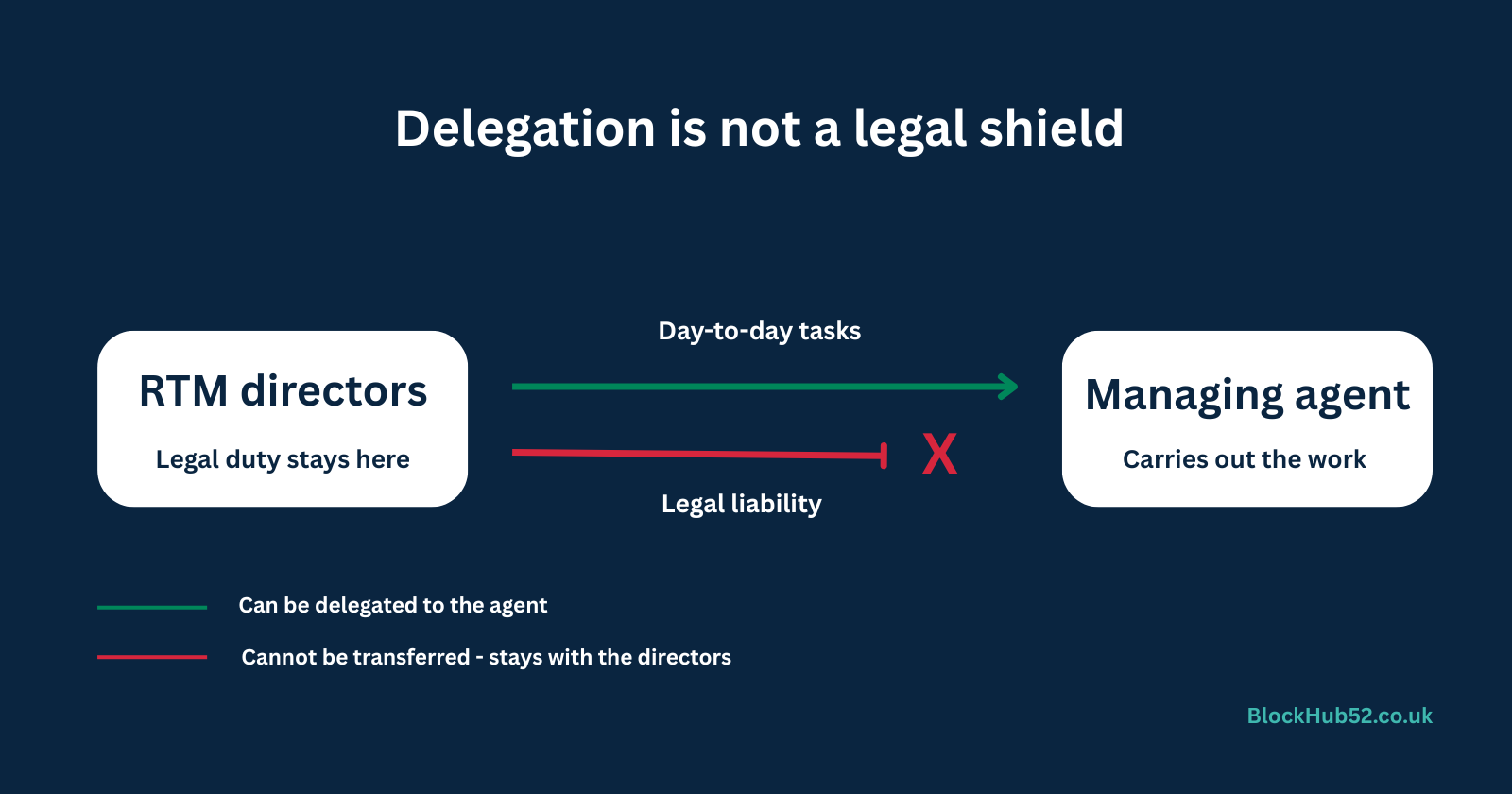
You can appoint a managing agent to carry out day-to-day tasks, organising contractors, collecting service charges, managing repairs. But the legal responsibility for compliance remains with the RTM company directors.
If your managing agent fails to arrange a fire risk assessment and there is an incident, the question of prosecution focuses on the responsible person. Under the Regulatory Reform (Fire Safety) Order 2005, that is the RTM company and its directors, not the agent.
Delegation is practical. It is not a legal shield.
Which Compliance Obligations Carry the Highest Personal Risk?
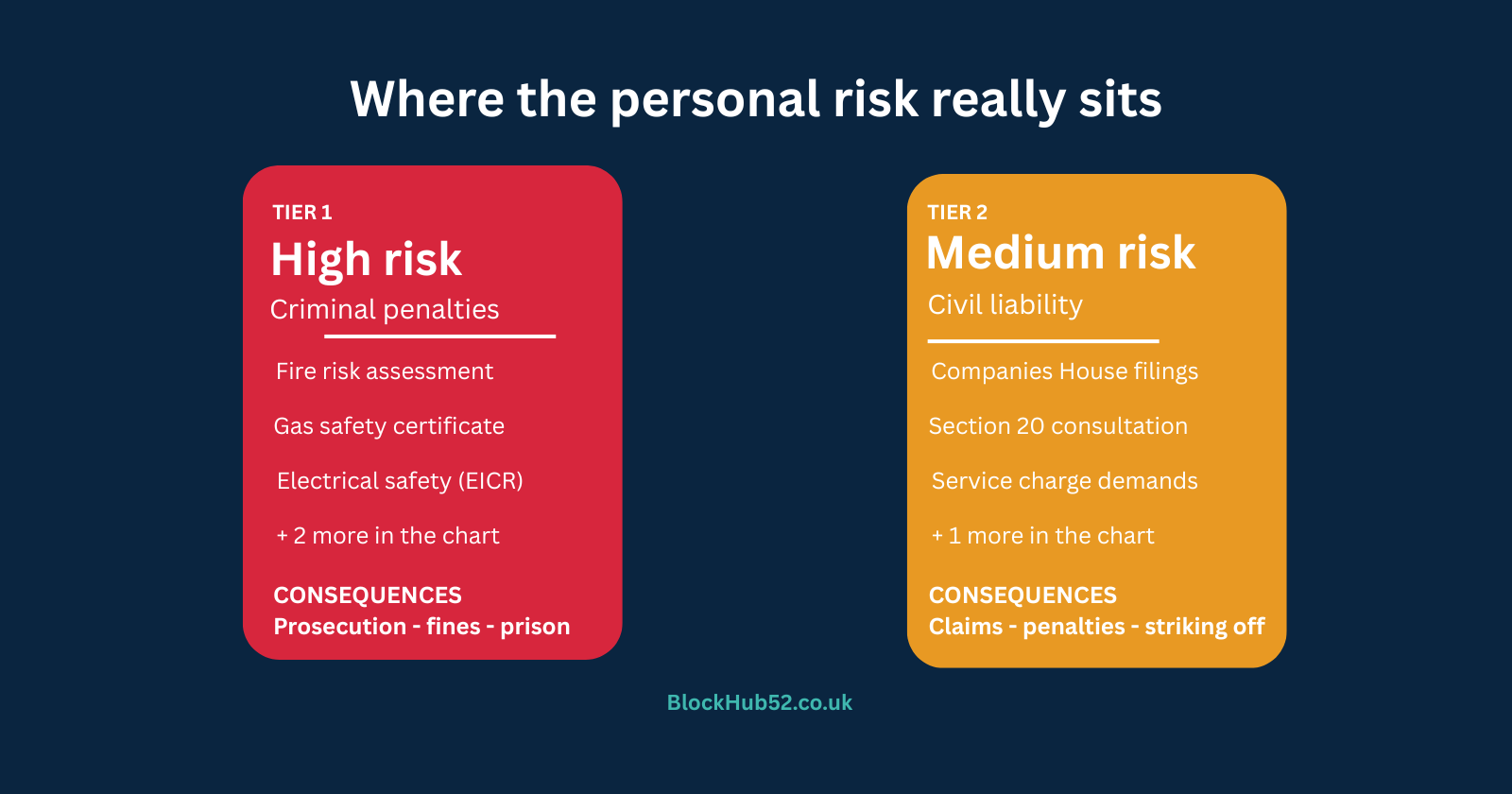
High risk, criminal penalties apply
- Fire risk assessment. Required under the Regulatory Reform (Fire Safety) Order 2005; failure to have one in place is a criminal offence
- Asbestos management plan. Required under the Control of Asbestos Regulations 2012 if asbestos is present or suspected in communal areas
- Legionella risk assessment. Required under the Control of Substances Hazardous to Health Regulations 2002 (COSHH)
- Gas safety certificate. Annual certificate for any communal gas appliances, required under the Gas Safety (Installation and Use) Regulations 1998
- Electrical installation condition report (EICR). Required for communal areas under the Electricity at Work Regulations 1989
Medium risk, civil liability and regulatory action
- Buildings insurance. RTM companies are typically obligated under the lease to maintain adequate cover
- Directors and officers (D&O) insurance. Protects directors personally against claims; not legally required but strongly recommended
- Companies House filings. Confirmation statements and accounts; missing these leads to automatic striking off
- Section 20 consultation. Failure to follow the correct statutory consultation process under the Landlord and Tenant Act 1985 when the cost of qualifying works means any one leaseholder would pay more than £250 means you cannot recover the excess through service charges
Download our free UK Block Compliance Wall Chart, the key statutory obligations on one page, with risk levels, frequencies, and a column to fill in your own due dates.
How to Protect Yourself as an RTM Director
The personal liability risk is manageable with good organisation. Here is what matters most:
- Get D&O insurance. Directors and officers insurance is specifically designed to protect volunteer RTM directors from personal claims. Many RTM companies choose to hold it.
- Maintain a compliance calendar. Know when each obligation falls due and who is responsible. A missed fire risk assessment renewal is significantly more dangerous than a missed contractor invoice.
- Document your decisions. Keep minutes of director meetings. If a decision is ever challenged, a paper trail showing you acted in good faith is your best protection.
- Understand your lease. The lease sets out many of your obligations. If you are unsure what it requires, ask a solicitor to review the key clauses.
- Keep service charge and reserve funds separate. Service charge money and reserve fund money are trust money. Keep them in bank accounts used only for that money, separate from the company's own money. This is best practice and is what the RICS code expects. Both are held on trust for leaseholders under section 42 of the Landlord and Tenant Act 1987, they are not company money. Note that some RTM companies also maintain a separate administration account for costs such as Companies House fees, D&O insurance premiums, and accountancy charges; this should also be kept clearly distinct from trust funds.
- File on time at Companies House. Late confirmation statements and accounts trigger automatic penalties. Set calendar reminders well in advance.
What Does the 2024 Leasehold and Freehold Reform Act Change?
The Leasehold and Freehold Reform Act 2024 strengthens RTM rights and makes it easier for leaseholders to take on the management of their building. The Commonhold and Leasehold Reform Bill, announced in the King's Speech 2025, goes further, with commonhold set to replace leasehold for new developments.
This means more buildings will be self-managed by volunteer directors in the coming years. The compliance obligations do not change, but the number of directors who need to understand them is growing.
Frequently Asked Questions
Can an RTM director be personally sued?
Yes. An RTM director can face personal legal action if they breach their duties as a company director, mismanage service charge or reserve funds held on trust, or fail to meet statutory health and safety obligations. Directors and officers (D&O) insurance is the primary protection against personal claims.
What happens if an RTM company fails to carry out a fire risk assessment?
Failure to have a current fire risk assessment is a criminal offence under the Regulatory Reform (Fire Safety) Order 2005. The responsible person, the RTM company and its directors, can face prosecution, unlimited fines, and up to two years' imprisonment in serious cases.
Does a managing agent take on the legal liability of an RTM company?
No. A managing agent acts on behalf of the RTM company but does not assume its legal liabilities. Responsibility for statutory compliance remains with the RTM directors. If the managing agent fails to carry out a required task, the directors remain liable for the consequences.
What is D&O insurance and do RTM directors need it?
Directors and officers (D&O) insurance protects individual directors from personal financial liability arising from claims made against them in their role as a director. It is not a legal requirement for RTM companies, but it is strongly recommended given the personal liability RTM directors carry.
What are the Companies House obligations for an RTM company?
An RTM company must file a confirmation statement at least once a year and submit annual accounts to Companies House. Failure to file results in automatic financial penalties and, if persistent, the striking off of the company. Directors of a struck-off company can face personal liability for actions taken after the striking off date.
Where to Start
If you have recently become an RTM director, two free resources will help you understand your obligations immediately:
- Free UK Block Compliance Wall Chart, the key statutory obligations on one page, with risk levels, frequencies, and a column to fill in your own due dates.
- Try BlockHub52 free for 45 days, compliance tracking and service charge management that automatically keeps you on top of every obligation, built specifically for self-managing RTM and RMC directors.
Related Reading
BlockHub52 provides general information only. Nothing in this article constitutes legal or financial advice. Always seek independent qualified advice for your specific situation.