Reserve Fund vs Sinking Fund: How Much Should Your Block Hold?
Reserve fund vs sinking fund for flats: are they different, does your lease allow one, and how much should your block actually hold? A plain-English director guide.

This article is general information, not legal or financial advice. Always take qualified professional advice for your own building.
The roof probably has another ten years in it. Probably. Nobody has actually been up there since you became a director, and the last time anyone mentioned a survey was at the meeting where you agreed to take the job on. There is some money sitting in the account. You are not sure whether it is enough, whether it is too much, or whether the company is even allowed to be holding it.
If that is roughly where you are, you are in the same position as most volunteer directors of a small block. Nobody hands you a method for working this out. This article gives you one, along with the rules that sit around it.
The short answer. A reserve fund and a sinking fund are the same thing in practice, and your lease decides whether your block is allowed to hold one at all. There is no standard amount. The right figure comes from your own building: take the replacement cost of each major item, the roof, the decorations, the windows, anything else the company must eventually replace, divide each cost by the number of years until the work is due, and add the results together. The figure is usually higher than directors expect. In the worked example further down, a nine flat block comes out at about £774 per flat per year.
What a Reserve Fund Is For
A reserve fund is money collected a little at a time, through the service charge, and set aside for the expensive jobs that only come round every few years.
Typical examples in a block of six to twenty flats:
- Roof covering. A flat roof might need recovering every twenty to twenty five years, a pitched roof less often, and the bill lands in one year rather than being spread across the twenty five that wore it out.
- External redecoration. Usually on a cycle written into the lease, often five to seven years, and predictable enough that there is no excuse for being caught out by it.
- Lift replacement or major refurbishment. Rare in the smallest blocks, but if you have a lift, it is almost certainly the single largest number on your list.
- Communal windows, doors and entry systems. Less dramatic than a roof, but a full window replacement across a block can easily run to five figures.
- Communal boilers, pumps, drainage and fire safety systems. Anything with a service life and a replacement cost belongs on the list.
The purpose is fairness as much as budgeting. The Royal Institution of Chartered Surveyors (RICS) Service Charge Residential Management Code, 4th edition, in force since 7 April 2026, puts it plainly: a reserve fund spreads the cost of using the building as evenly as possible across the life of the lease, so that the leaseholders who happen to own their flats in the year the roof is replaced are not the only ones who pay for twenty five years of wear.
The Leasehold Advisory Service (LEASE) makes the same point from the leaseholder's side. The fund exists so that everyone contributes to major work, not just whoever is unlucky enough to be in occupation when the scaffolding goes up.
There is a practical benefit too. A block with a healthy, properly evidenced reserve fund is easier to sell a flat in. Buyers and their solicitors ask about it, and a well funded building is a sign that the block is being run properly.
Reserve Fund vs Sinking Fund: Is There a Difference?
In everyday use, no. For a residential block, the two words are used to mean the same thing.
There is a technical distinction that some accountants and surveyors still draw:
- A sinking fund is money saved towards replacing a specific major asset at the end of its life. The lift. The roof. One item, one pot.
- A reserve fund is money saved to smooth out costs that recur on a cycle, or that vary a lot from year to year. External redecoration is the classic example.
That distinction can be useful when you are planning, because it makes you think about individual assets rather than one vague pot of money. Legally it makes almost no difference. The RICS Service Charge Residential Management Code notes that the two terms have become interchangeable, and uses "reserve fund" throughout. LEASE treats them as the same thing.
What actually matters is not which word your lease uses. It is three other things:
- Whether the lease permits the collection at all. The label is irrelevant if the power is not there.
- What the money can be spent on. Some leases create a general fund for future costs. Others tie the money to named items, and spending it on something else would be outside the lease.
- Whether the money is properly separated and accounted for. That obligation is the same either way.
So if your lease says "sinking fund" and your accountant says "reserve fund", nobody is wrong. Read the clause, not the heading.
Does Your Lease Actually Allow a Reserve Fund?
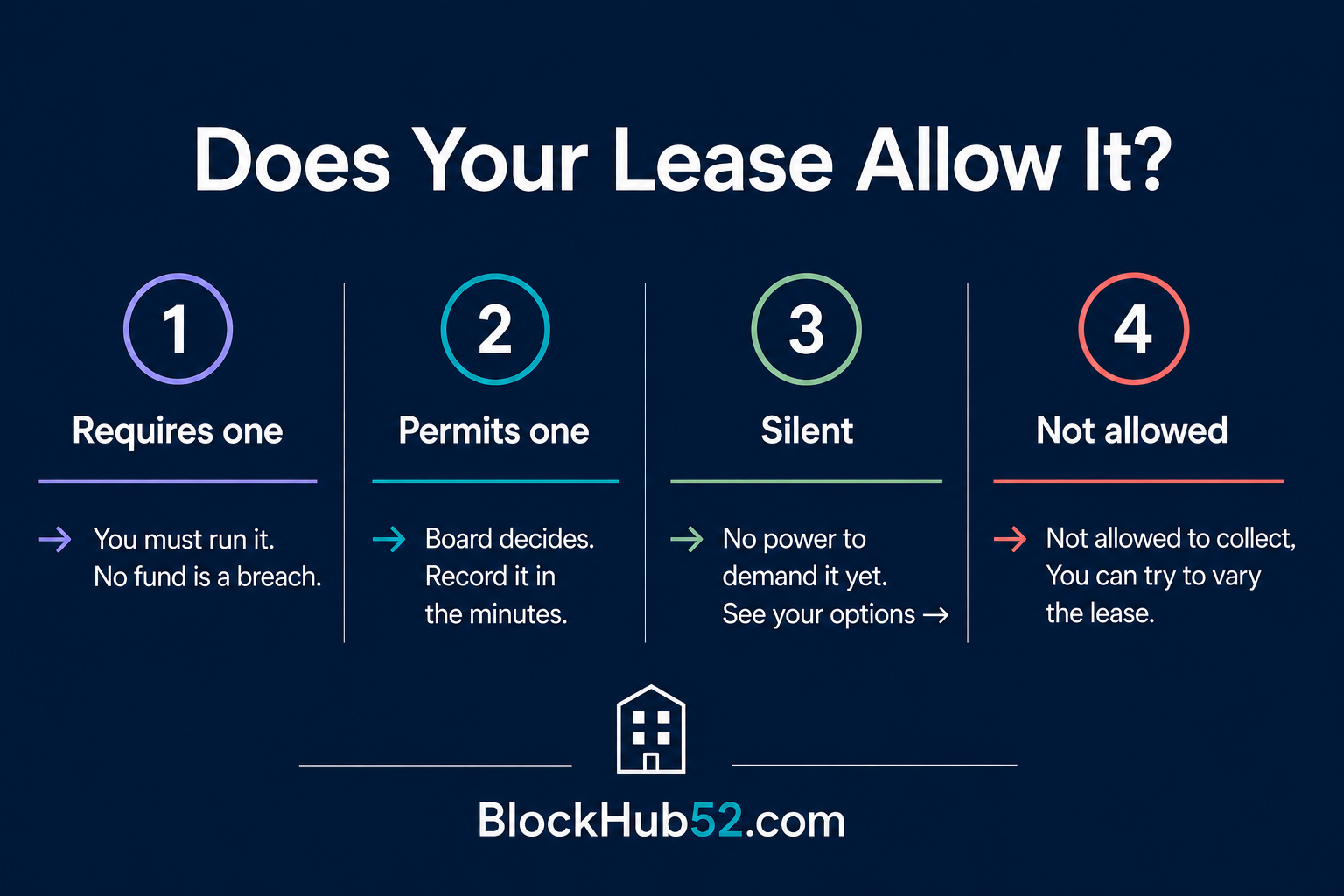
This is the question to settle before any other, and it is the one most often skipped.
There is no general right to collect reserve fund contributions. The power has to come from the lease. LEASE states the position directly: a landlord can only collect payments into a reserve fund where the lease specifically allows it. That applies just as much to a Right to Manage (RTM) company or a Residents' Management Company (RMC) as it does to a commercial freeholder.
Read the service charge clauses in one of the leases, and check whether the wording covers collecting or retaining money for costs to be incurred in future years. Then check that the other leases in the block say the same thing, because they are not always identical.
You will land in one of four places.
- The lease requires a reserve fund. Some leases say the company "shall" establish and maintain a fund. If yours does, running the block without one may amount to a breach of the lease terms. The RICS Code is explicit that where the lease says a fund must be set up, it must be set up. This is the situation directors are most surprised by, because a fund that was never started does not announce itself.
- The lease permits a reserve fund but does not require one. This is the most common wording. The decision is yours as a board, and the RICS Code treats holding a fund as good practice wherever the lease permits it. Record the decision and the reasoning in the minutes, because a future director will want to know why the fund was set at the level it was.
- The lease is silent. No mention of a reserve fund, a sinking fund, or holding money back for future costs. Silence on its own does not create a power to demand contributions through the service charge. Silence is also not a reason to hold nothing, because the roof will still need replacing and the money will still have to come from the leaseholders, just all at once and at the worst possible moment. This is the real decision point, and it is where most blocks in this position get stuck. Read the clauses carefully before concluding you are here, because some leases allow income to be retained towards costs to be incurred in later years without ever using the words "reserve fund" or "sinking fund". If you are genuinely here, the section below sets out what you can do.
- The lease expressly prohibits collecting in advance. Rare, but it exists, and it is a different position from silence. Varying the leases is the only clean route, and collecting anyway is the thing not to do.
What you must not do, in either of the last two cases, is start demanding reserve fund contributions as though the lease allowed it. Money demanded without lease authority is money the company had no right to demand, and a leaseholder can challenge it.
If Your Lease Is Silent: What You Can Actually Do

Being in this box is a decision, not a dead end. There are four routes, and they are not equally good.
- Tell leaseholders plainly what is coming. The minimum honest option. Set out the major items, rough costs and rough timings in writing, once a year, so every leaseholder can save privately towards their own share. It funds nothing, but it means nobody can say they were not told, and it is often the step that persuades a block to do one of the things below.
- Collect voluntary contributions by agreement. Leaseholders can agree to pay into a fund even where the lease does not require it. Understand what this is and what it is not. Because the money is not payable under the lease, it is probably not a service charge, which means it probably does not carry the protection of the trust in section 42 of the Landlord and Tenant Act 1987. The legal position is not settled, and that includes whether a contributor could later seek repayment. If you take this route, hold the money in a clearly ring-fenced account, write down what it is for and what happens to it, get every contributor to agree those terms in writing, and take advice on the documentation. Opening a separate savings account and hoping is not the same thing as protecting the money, and do not tell leaseholders their contributions are protected in the way service charge money is.
- Vary the leases by agreement. All the parties to the leases sign a deed of variation adding a reserve fund clause. This is the permanent fix. It puts the fund on the same footing as any other service charge, which means it is demandable, it is covered by the statutory trust, and it binds future owners. In a small block where everyone is in the same room at the annual general meeting, it is more achievable than it sounds. There are legal costs, and each lender may need to consent or at least be notified, depending on the circumstances.
- Apply to the tribunal to vary the leases. Where agreement cannot be reached, an application can be made to the First-tier Tribunal (FTT) under Part 4 of the Landlord and Tenant Act 1987. Section 35 allows the tribunal to vary certain defective leases, including where a lease fails to make satisfactory provision for the recovery of expenditure "incurred or to be incurred", which is the wording a reserve fund application turns on. The tribunal is not obliged to grant an application. Section 37 allows a group application without unanimity: for fewer than nine leases, all or all but one of the parties must consent, and for more than eight leases, no more than 10 per cent may oppose and at least 75 per cent must consent.
One thing to check before you start. Section 35 lets a party to the lease apply. Because an RTM company is generally not a party to the leases it manages, an application will usually need to be made by a leaseholder or the landlord rather than by the RTM company itself. An RMC named as a party in the leases is usually in a different position. Take advice on who applies before spending anything.
Whichever route you take, from an accounting standards perspective, it is preferable to keep reserve money separate from day to day money. Where the reserve fund forms part of the service charge under the lease, the statutory trust provides important protections. Voluntary arrangements do not automatically get those protections, which is why they need careful documentation and separate handling.
If the Decision Is Yours: The Case for Running a Reserve Fund
Where the lease permits a fund but does not insist on one, the board has to decide, and then has to persuade the members. Raising the service charge is never a popular proposal, so it helps to have the arguments set out properly. These are the points that tend to carry a meeting.
- The money never leaves the leaseholders. This is the objection to deal with first, because someone always raises it. Reserve fund contributions are not company income and they are not a fee. Section 42 of the Landlord and Tenant Act 1987 means the money is held on trust for the leaseholders as a group, ring-fenced for the building, and shown in the accounts every year. Nobody is handing money away. They are moving it from their own account into the building's account.
- It shares the cost fairly between everyone who wears the building out. A roof deteriorates over twenty five years. Without a fund, it is paid for entirely by whoever happens to own a flat in the year the scaffolding goes up, including people who moved in eighteen months earlier. The RICS Code describes spreading cost evenly across the life of the lease as the whole point of a reserve fund. Every leaseholder in the room will be on one side of that line or the other at some point.
- A large one-off demand is the thing that actually stops work happening. A £45,000 roof split across nine flats is £5,000 each, arriving in one letter. Some households will not have it. Unpaid demands mean the company cannot pay the contractor, the work slips, the defect worsens, and the eventual bill is larger. Collecting steadily is the difference between a repair that happens on schedule and one that happens after the ceiling stains appear.
- It protects the flat's value and makes it easier to sell. Buyers' solicitors ask about major works and reserves during conveyancing. A block with a funded reserve and a written plan answers those enquiries cleanly. A block with neither invites the buyer to reduce their offer by the cost of the works they can see coming. LEASE makes the point that a reserve fund may add to the value of the property.
- It protects the directors as well as the building. Contributions have to be reasonable, and a leaseholder can challenge them at the FTT. A figure backed by a survey and a costed plan is evidence. A figure someone picked because it sounded about right is an opinion. The board that can show its working is in a very different position from the board that cannot.
- The rules are moving in this direction anyway. Reserve funds are not compulsory today, and the government has consulted on making them so. Separately, from 2027 there will be a requirement to give leaseholders an annual report covering the condition of the building and forthcoming major works. A block already planning ahead has that conversation half finished.
A figure backed by a survey and a costed plan is evidence. A figure someone picked because it sounded about right is an opinion.
The honest counter-argument, which is worth putting to the meeting yourself rather than waiting for someone else to: contributions raise the service charge now, and they are generally not refundable when a leaseholder sells, so a member planning to move in two years is paying towards work they will not see. The answer is that the money follows the flat rather than the person, and shows up in what the flat is worth and how easily it sells. That is a real trade-off, not a knock-down argument, and members respect a board that says so.
How Much Should Your Block Hold?
How much a block should hold is decided by the building, not by a standard figure. Put a replacement cost and a remaining life against each major item, divide each cost by the years until the work is due, and add the results together. That total is the block's yearly reserve fund contribution, which is then split between the flats using the percentages in the leases.
There is no correct national figure, and any rule of thumb you find online is a sanity check at best. A ten flat 1930s conversion with a slate roof and no lift has almost nothing in common with a twenty flat 2006 block with a lift, a communal boiler and a flat roof.
What there is, though, is a method. It is the same method a professional would use, just at a scale you can manage yourself.
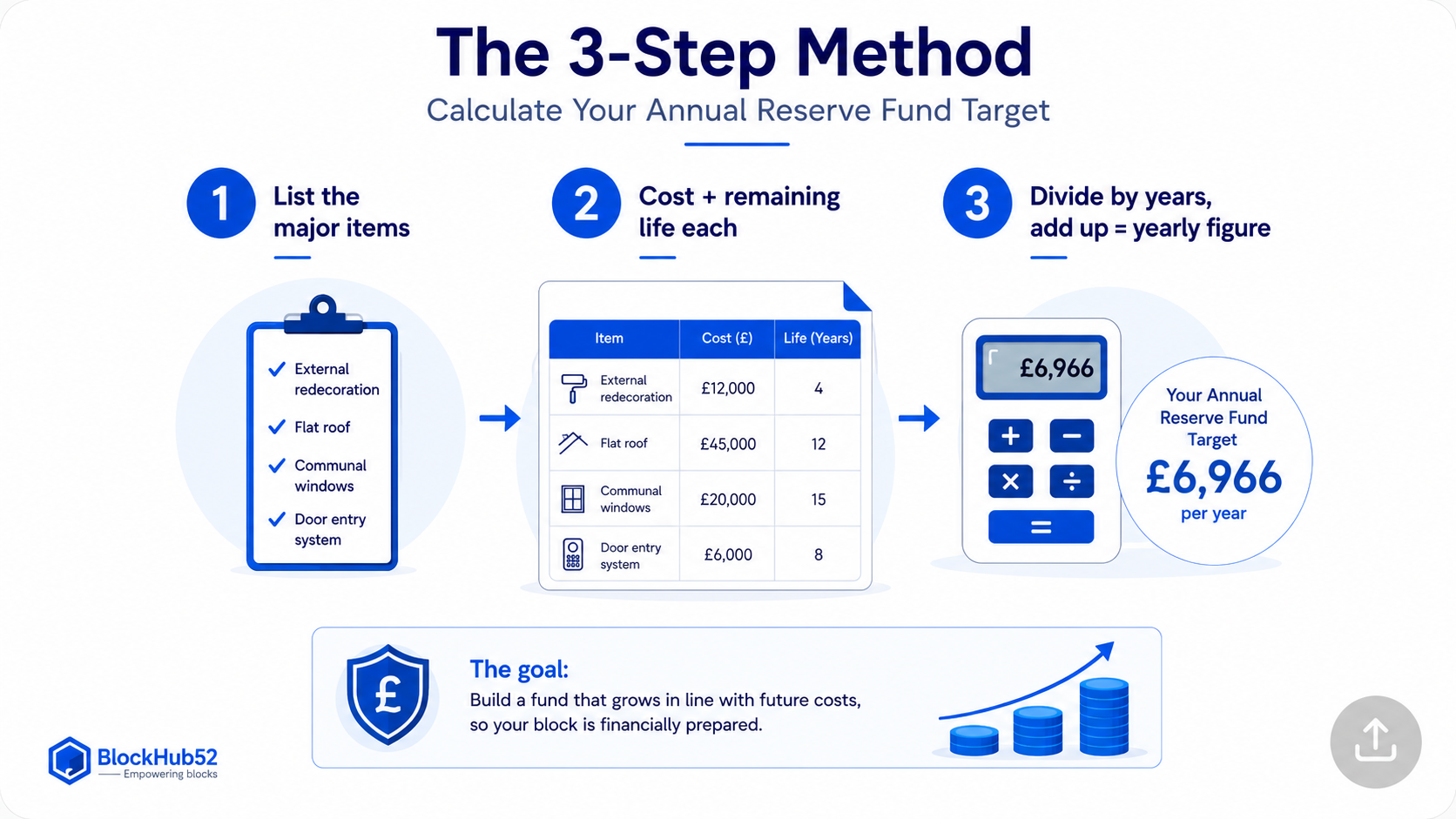
Step one: list the major items
Walk the building and write down everything that is the company's responsibility to repair or replace and that will not last forever. Roof. External decoration. Windows and communal doors. Entry system. Lift. Communal heating. Drainage. Fire alarm and emergency lighting. Car park surface, boundary walls and fencing if they are yours.
Check the lease while you do it, because the list is defined by what the company is responsible for, not by what you can see from the front path.
Step two: put a remaining life and a cost against each item
This is the part that feels like guesswork, and it is the part where a little professional help is worth paying for.
- Get a condition survey if you have never had one. For a small block, a surveyor's report on the main building elements gives you remaining lives and indicative costs, which is exactly what you need. The RICS Code recommends that every building has a costed planned preventative maintenance plan reflecting the age and condition of the building, covering at least three years, and longer for larger or more complicated developments. For simple blocks it accepts an assessment based on the age and condition of the building together with likely future cost estimates.
- Use real quotes where you have them. If you had the outside painted three years ago, you know what the next redecoration will cost, roughly, before inflation.
- Be honest about the unknowns. "Roof: probably fine for now" is not a remaining life. If nobody knows, that is a reason to get someone up there, not a reason to leave the line blank.
- Allow for costs rising. Building costs do not stand still over a fifteen year horizon. Either uplift your cost estimates or accept that you will need to revise the figure upwards at each annual review.
Step three: turn the plan into a yearly number
For each item, the annual provision is roughly:
(estimated cost, less anything already reserved for that item) divided by the number of years until the work is due.
Add the annual provisions together and you have the reserve fund contribution for the whole block. Then apportion it between the flats using the percentages in the leases, not by dividing by the number of flats, unless the leases actually say equal shares.
A worked example for a nine flat block
Say the block already holds £15,000 in reserves, and the surveyor's report gives you this:
| Item | Estimated cost | Years until due | Already reserved | Annual provision |
|---|---|---|---|---|
| External redecoration | £12,000 | 4 | £4,000 | £2,000 |
| Flat roof recovering | £45,000 | 12 | £8,000 | £3,083 |
| Communal windows | £20,000 | 15 | £3,000 | £1,133 |
| Door entry system | £6,000 | 8 | £0 | £750 |
| Total | £15,000 | £6,966 |
Worked example: a nine flat block already holding £15,000 in reserves
That is roughly £7,000 a year for the block. On equal shares across nine flats, about £774 per flat per year, or £65 a month, on top of the day to day service charge.
The figure will look uncomfortable written down. It should. It is the real cost of owning the building, which was always there, just invisible.
What to do if the number looks unaffordable
Sometimes the honest answer is that the block cannot fund the plan at the rate the plan implies. That is information, not a failure.
- Look again at the timing, not the total. If a non urgent item can safely be pushed out five years on a surveyor's advice, the annual figure falls. If it cannot be safely deferred, do not pretend that it can.
- Phase the contributions. Stepping up over three years is easier to carry than a sudden jump, and easier to explain at the annual general meeting.
- Say out loud what the alternative is. If the block funds at half the required rate, there will be a large one off demand at some point. Leaseholders are entitled to know that, and most would rather know now.
- Never quietly under fund and hope. A reserve fund set at a comfortable number rather than a calculated one is the single most common problem in small blocks, and it always lands on somebody eventually.
One more point on the level. Contributions to a reserve fund are part of the service charge, and like any other service charge they have to be reasonable. A leaseholder can challenge them at the FTT. A costed maintenance plan is what turns your figure from an opinion into evidence, which is why the plan matters as much as the number.
How Reserve Fund Money Must Be Accounted For

Reserve fund money is service charge money, which means it is trust money. Section 42 of the Landlord and Tenant Act 1987 provides that service charge contributions are held on trust to meet the costs they were collected for, and otherwise for the contributing leaseholders. It is the residents' money in the company's safekeeping.
Three practical consequences follow.
- Show the reserve fund separately in the accounts. The admin fund pays this year's running costs. The reserve fund is saving for jobs years away. If the two are added together into one figure, nobody can tell whether the building is actually saving enough, including the board. The Institute of Chartered Accountants in England and Wales (ICAEW) technical release TECH 03/11, which is the specialist standard for residential service charge accounts, expects the funds to be reported separately with their own opening and closing balances.
- Keep the money separate from the company's own money. That much is a legal requirement of the trust. Holding the admin fund and the reserve fund in two different bank accounts is a further step, and it is best practice rather than a statutory duty. Section 42A of the Landlord and Tenant Act 1987, which would require a designated account, was added in 2002 but has never been brought fully into force. Even so, the RICS Code treats two accounts as best practice, and two accounts make it far harder to spend the wrong money by accident.
- Interest belongs to the fund, and there may be tax to deal with. Interest earned on reserve fund money is added to the fund. It does not belong to the company. Interest may be taxable, depending on the trust's circumstances, and a trust tax return can be required. Since 6 April 2024, trusts with total income of £500 or less in a tax year do not report or pay tax on that income. Many small blocks sit under that figure and some do not, and the position is not one to guess at. Ask an accountant who genuinely does residential service charge work.
Keeping three sets of money properly apart, the company's own money, the admin fund and the reserve fund, is the part that is tedious by hand and quietly easy to get wrong in a spreadsheet. It is one of the reasons BlockHub52 was built with the three kept separate from the start, ready to use rather than something you have to design yourself. Every payment is recorded against the right one, the reserve fund balance is a live figure rather than something worked out at year end, and the two funds come out separately in the accounts because they were never mixed in the first place.
Spending the Reserve Fund
Having the money is only half of it. Spending it correctly is the other half, and this is where directors acting in good faith most often go wrong.
- Spend it in accordance with the lease. The lease is what defines the permitted use, and leases vary more than directors expect. Some create a general fund and allow fairly broad expenditure on future costs. Others tie the money to named items, in which case spending it elsewhere would be outside the lease. Read the clause before you spend, not after.
- Do not use it to plug a day to day shortfall. The RICS Code is firm on this. Reserve funds should not subsidise day to day service charge expenditure, cover routine maintenance, or make up for leaseholders who have not paid. The only exception it recognises is a very short term cash flow problem where you know exactly how and when the money will be repaid, and it is repaid in full at the earliest opportunity.
- Section 20 consultation still applies. This one catches people out constantly. If qualifying works will cost any single leaseholder more than £250, you must consult under section 20 of the Landlord and Tenant Act 1985, in the prescribed form, even where the money is already sitting in the reserve fund. Having saved up does not remove the obligation to consult. Skip the consultation and the company's recovery can be limited to £250 per leaseholder, and the reserve fund does not protect you from that outcome.
- Do not commit before the money is there. The RICS Code advises against committing to expenditure unless funds are available to cover the cost in full. Signing a contract on the assumption that leaseholders will pay a shortfall on demand puts the company at risk.
The Mistakes Directors Make Most Often
None of these are dramatic. They are the ordinary slips a busy volunteer makes, and every one of them is avoidable.
- Collecting without checking the lease. The board agrees a reserve fund because it is obviously sensible, and nobody reads the clause. If the power is not in the lease, the demand is not valid, however sensible the intention.
- Running the two funds as one pot. Money goes into one account, comes out of one account, and the accounts show one balance. It works fine until the year you need to know how much is actually available for the roof, and the answer is that nobody can tell you.
- Setting the figure by feel. Picking a round number that seems about right, with no survey and no plan behind it, gives you nothing to point at if a leaseholder challenges the contribution, and no way of knowing whether the block is on track.
- Under funding on purpose to keep the service charge low. Popular in the short run, and the cause of almost every large emergency demand you read about. The cost does not go away. It simply lands on whoever is unlucky enough to own a flat in the year the work becomes unavoidable.
- Dipping into the reserve to cover arrears. One leaseholder does not pay, the year end looks short, and the reserve fund quietly makes up the difference. That is using leaseholders' savings to cover somebody else's debt, and it may amount to a breach of trust.
- Skipping section 20 because the money is already saved. Covered above, and worth repeating, because it is expensive.
- Keeping the plan in one person's head. The director who knows the roof was patched in 2019 and that the surveyor said twelve years is also the director who will step down one day. A written plan, reviewed each year and stored where the whole board can reach it, is what lets the next director inherit a system rather than a shoebox. This is a large part of why we built BlockHub52 the way we did. The plan, the figures, the demands and the paperwork sit with the building rather than with whoever is currently doing the job, so directors can come and go and nothing has to be reconstructed from memory.
The cost does not go away. It simply lands on whoever is unlucky enough to own a flat in the year the work becomes unavoidable.
Where the Law on Reserve Funds Is Heading
Reserve funds are not compulsory today. They may not stay that way.
In July 2025 the government consulted on strengthening leaseholder protections, and one of the proposals was to make reserve funds mandatory in both new and existing leases, backed by a professionally certified asset management plan. The government published its response on 15 July 2026. On mandatory reserve funds specifically, it said it will respond separately in due course, so nothing has been decided yet.
What the response did confirm still matters to you. The government has stated that it intends to introduce a standardised framework for service charge accounts, with a prescribed minimum content that includes a balance sheet, an income and expenditure account with explanatory notes, reserve or sinking fund statements where applicable, and an aggregate figure for unpaid service charges. Private landlords, a term that expressly includes RTM companies and RMCs, are to be given twelve months' notice, with the changes expected to begin from 2027, subject to commencement regulations. The detail will come through statutory instruments that have not yet been made.
The practical read across is simple. A block that already keeps its reserve fund separately identified, backed by a costed plan and reported on its own line, is doing now what the accounts framework is heading towards anyway. A block running one undifferentiated pot has work coming.
Frequently Asked Questions
Is a sinking fund the same as a reserve fund?
For a residential block, treat them as the same thing. Some professionals still distinguish between a sinking fund saved towards replacing one specific asset and a reserve fund smoothing out recurring cyclical costs, and that distinction is useful for planning. The RICS Code records that the terms have become interchangeable and uses "reserve fund" throughout. What matters is what your lease permits and what the money can be spent on, not which word appears at the top of the clause.
How much should a block hold in its reserve fund?
There is no standard figure and no percentage that works across every building. The amount comes from the building itself. List each major item the company is responsible for replacing, put a replacement cost and a remaining life against each one, divide each cost by the number of years until the work is due, and add the results together. That total is the yearly contribution for the whole block, which is then split between the flats using the percentages in the leases. The result is often higher than directors expect. In the worked example in this article, a nine flat block with no lift comes out at about £774 per flat per year, and your own building will differ. A condition survey is what turns those estimates into figures you can defend if a leaseholder challenges them.
Can we start a reserve fund if the lease does not mention one?
Not by simply deciding to. Contributions can only be demanded where the lease gives the power, so silence means the company cannot put a reserve charge on a service charge demand. Read the service charge clauses carefully first, because some leases allow income to be retained towards costs to be incurred in later years without ever using the words "reserve fund" or "sinking fund". If there is genuinely no power, silence is a decision point rather than a dead end. You can tell leaseholders clearly what is coming so they save privately, you can collect voluntary contributions by agreement, or you can vary the leases, either by a deed of variation everyone signs or by applying to the FTT under Part 4 of the Landlord and Tenant Act 1987. Voluntary contributions are the weakest of these, because money not payable under the lease is probably not a service charge and the position on trust protection is not settled, including whether a contributor could later seek repayment. Take advice before choosing a route.
Do we need a separate bank account for the reserve fund?
Not as a matter of law. Service charge money must be held on trust and kept separate from the company's own money, but holding the admin fund and reserve fund in two separate accounts is best practice rather than a statutory requirement. Section 42A of the Landlord and Tenant Act 1987 would require a designated account, and it has never been brought fully into force. Two accounts are still worth having, because they make it much harder to spend reserve money on day to day costs by mistake.
Do we still have to consult under section 20 if the money is already in the reserve fund?
Yes. Where qualifying works will cost any one leaseholder more than £250, the section 20 consultation process under the Landlord and Tenant Act 1985 must be followed in the prescribed way, even if the whole cost is being met from reserves. Having the money saved changes how the work is funded. It does not change the consultation duty.
Can a leaseholder get their reserve fund contributions back when they sell?
Usually not. Contributions are generally not repayable on sale, and the money stays with the building for the benefit of the leaseholders as a group. A small number of leases provide otherwise, so the lease has to be checked. The money is not lost, though. A well funded reserve is a selling point, and the buyer inherits the benefit of it.
How often should we review the figure?
Review the contribution every year as part of setting the budget, and revisit the underlying survey or condition assessment every three to five years, or sooner after any significant work or defect. Costs change, remaining lives shorten, and a plan that is never revisited stops being evidence of anything.
Where to Start
If you have recently taken over your block, two free resources will help you get the basics in place straight away:
- Free UK Block Compliance Wall Chart. The most important statutory deadlines in one page.
- Try BlockHub52 free for 45 days. Service charge tracking and compliance built for self-managing RTM and RMC directors, so the company money, the admin fund and the reserve fund are accounted for separately.
Related Reading
BlockHub52 provides general information only. Nothing here is legal or financial advice. Always take independent qualified advice for your own situation.